BIG NEWS - Royal Mail scales up with Paxster electric delivery vehicles


Customer stories
When every minute and logistics matter
24. September 2026
During Norway Cup, thousands of people, large areas and a packed match schedule all need to be managed at the same time. For Norsk Folkehjelp Oslo (Norwegian People’s Aid), this means providing emergency preparedness across several venues, with equipment and supplies that need to get where they are needed. During this year’s event, the organisation used four Paxsters for both first aid response and logistics.
One Paxster Cargo, one Cargo XL and two Compact models were given different tasks throughout Norway Cup week. What they had in common was the need to move quickly and easily through areas where distances, crowds and activity place limitations on which vehicles are suitable. For Norwegian People’s Aid, the Paxsters became part of the operation that kept both emergency response and logistics running throughout the event.
Faster response across the outer fields
At Rustad and Abildsø, Norwegian People’s Aid used the two Paxster Compact models. Here, there are considerable distances between some of the pitches and the first aid stations.
When an incident occurs out on the field, getting there quickly to assess the situation can be important. The Compact models made it possible to bring the necessary equipment directly to the incident and quickly determine whether further assistance was needed.
The Paxsters allowed us to get equipment out to the fields quickly and make an early assessment of the situation. With the long distances at Rustad and Abildsø, they were extremely useful for us.
Trond Eidsvold, Norsk Folkehjelp
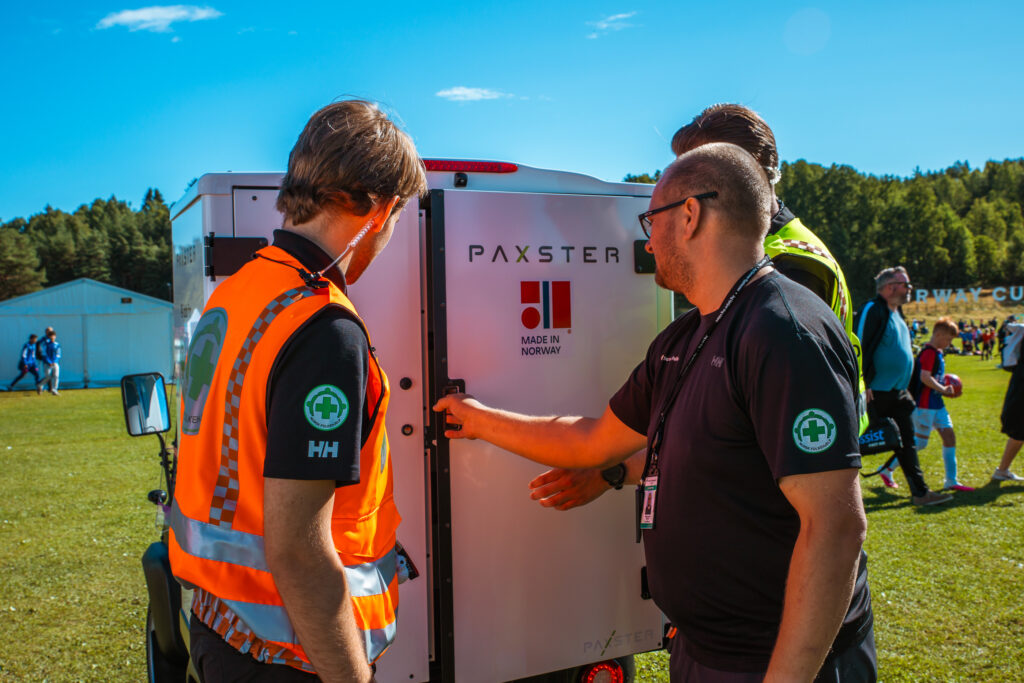
Photo: Therese Lerbæk
Logistics for 120 crew members
At Ekeberg, the tasks were different. Here, the Paxster Cargo was used to deliver equipment and food to the various stations. The Cargo XL handled the larger transport tasks and played an important role in food logistics. Around 120 crew members needed breakfast, lunch and dinner throughout the week, which meant large quantities of food and equipment had to be moved every day. With its large cargo capacity, substantial loads could be transported in a single trip, while the vehicle remained compact enough to move easily around the event area.
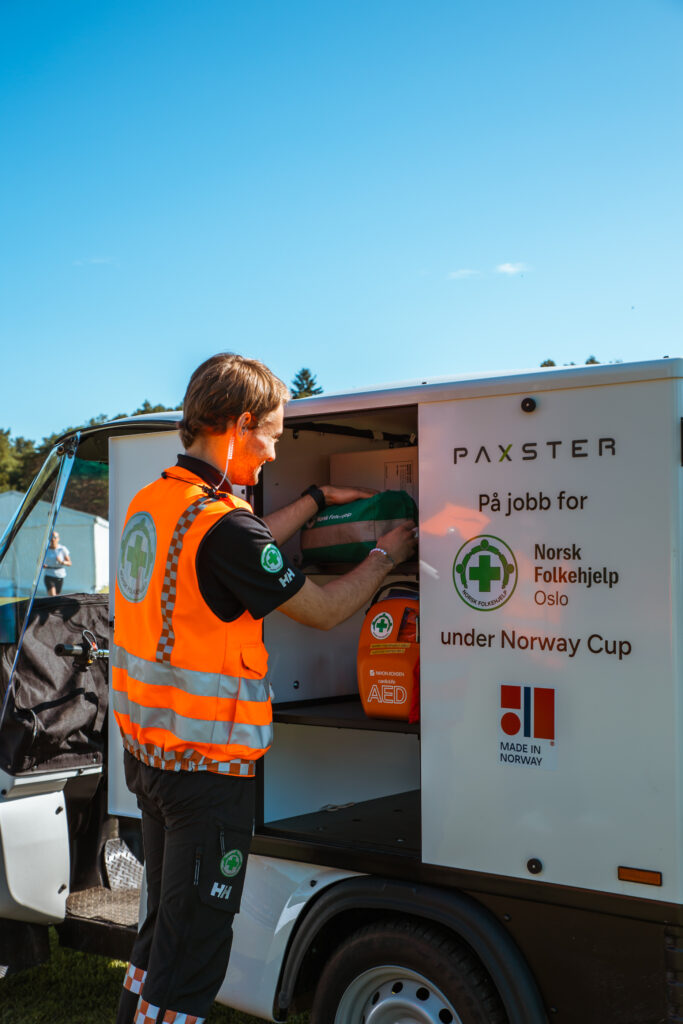
Photo: Therese Lerbæk
From football pitches to public roads
At an event like Norway Cup, cargo capacity is not the only consideration. The vehicles need to move among football players, spectators and volunteers, across grass areas and between different venues. Eidsvold highlights the combination of cargo capacity, compact size and low weight as particularly useful. The fact that the Paxsters are electric was another advantage, allowing them to operate around large crowds without exhaust emissions and with minimal noise. At the same time, the vehicles could move from the large grass fields onto public roads whenever the task required it.
The combination of good cargo capacity and compact size worked very well for us. We could use the vehicles both out on the grass fields and on public roads, and electric operation was a clear advantage at an event with so many people.
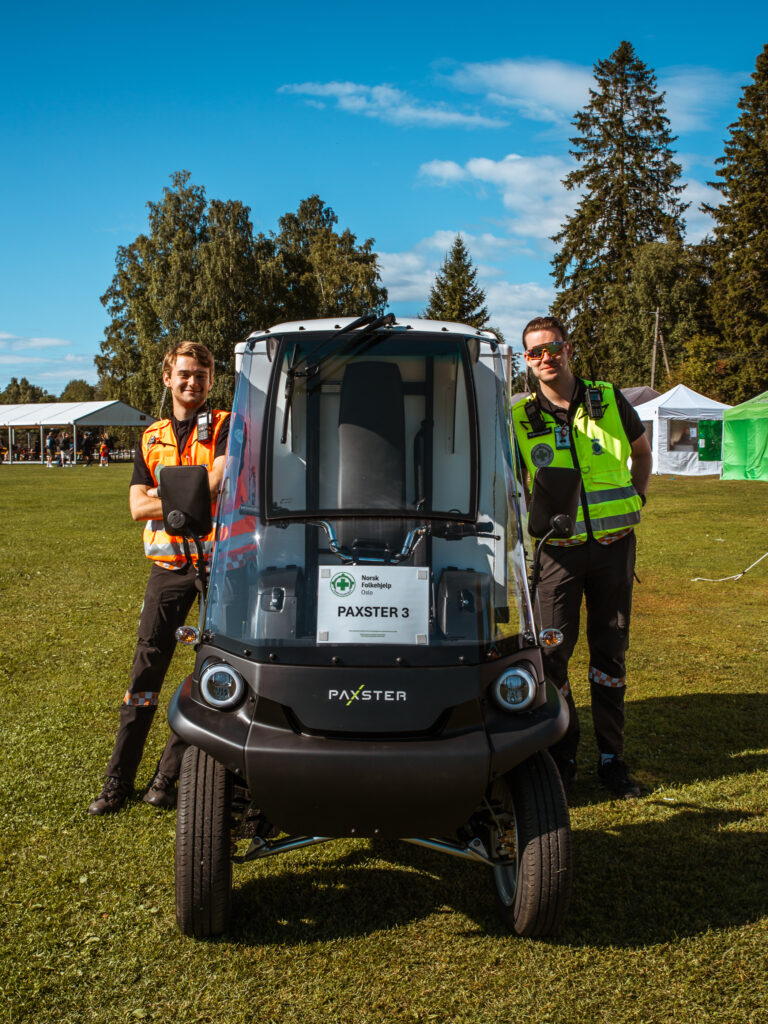
Photo: Therese Lerbæk
Easy to recognise when help is on the way
During the event, all four vehicles carried Norwegian People’s Aid branding. This also served a practical purpose. As the Paxsters moved among the many participants and visitors, it was easy to recognise them as part of the emergency response team. Norwegian People’s Aid found that people were considerate and made way for the vehicles as they moved through the event.
Having our logo on the Paxsters worked extremely well. It made us easily recognisable as part of the emergency response team, and people were considerate and made way for us as we drove around.
Throughout Norway Cup week, the four Paxsters handled a wide range of tasks; from getting first aid equipment quickly out to the football fields to helping ensure that around 120 crew members received their meals. For Norwegian People’s Aid, it ultimately came down to the same thing: getting people, equipment and supplies where they needed to be, when they needed to be there.
Do you also want to work smarter - and at the same time reduce emissions and noise?
Others also read:
Gaupen Planter found an alternative to an ATV
At Gaupen Planter, distances are long, the passages between the greenhouses are narrow, and the ground conditions are not always easy. When Rune wanted a more efficient way to move between the growing fields, he found a Norwegian utility vehicle that has surprised him in more ways than one. At Gaupen Planter, large areas need to be monitored throughout the
Keep reading
Efficient artificial turf maintenance with Paxster
When Manglerudhallen was looking for a machine to maintain its new artificial turf, the requirements were clear: it had to be powerful enough to pull the maintenance equipment, easy to use and flexible enough to handle several tasks around the facility. After testing the Paxster Air+, they found what they were looking for. Manglerudhallen has recently undergone a renovation worth
Keep reading
Smooth and efficient park maintenance in Frognerparken
When the working day takes you back and forth across one of Oslo’s largest parks, getting around efficiently is essential. For Henriette, a landscape gardener with Skaaret Landskap, the Paxster Air+ has become a working tool she would rather not be without. – I love it! That was the first thing Henriette said when we met her at work in
Keep reading

 English
  Norwegian